

Leadership development: simply leading effectively
Management development is a key element of employee retention: it combines skills and personal development on the one hand with recognition and appreciation of key performers on the other.
We see leadership development as a process in which people grow into their leadership role and the associated tasks. They gradually acquire the necessary skills and activate their strengths and talents to lead employees successfully in the long term.
We support managers in consciously fulfilling their central role in constant change processes, providing orientation and developing the necessary skills.
We empower managers to create an inspiring and meaningful working environment in which everyone feels valued, develops their full potential and at the same time efficiently achieves the company’s goals.
In doing so, we promote a culture that strengthens collaboration in the long term and enables individual development. Well-trained managers with a modern mindset have a positive impact on the satisfaction and motivation of all employees.
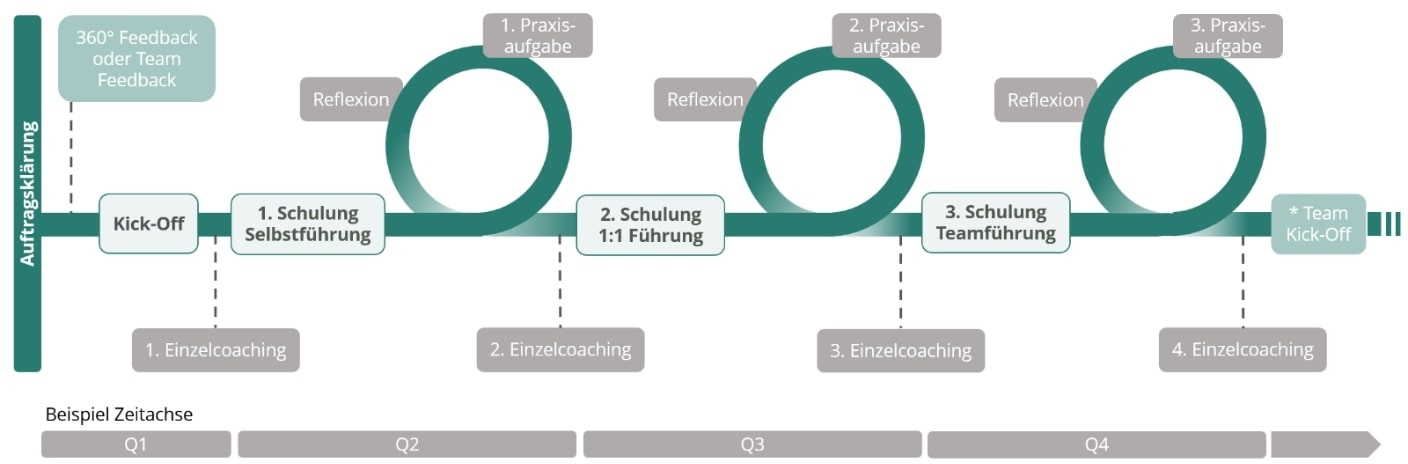
We offer modular formats for leadership development – tailored to maturity level, role and needs. Whether basic leadership training, specific training for individual skills or our holistic development program: managers bring in their own topics, learn from each other and take responsibility for their development through reflection, practical transfer and participation.



Possible reasons for management development
Leadership today is under particular tension: between increasing demands, growing complexity and the need to lead people effectively and healthily. Routines that used to work are often no longer enough. Leadership development becomes relevant when new skills, attitudes and clarity are needed – especially in phases of change, growth or increased uncertainty.
In change processes and times of fundamental change
Reorganizations, strategic realignments, digitalization or cultural change require leadership that provides orientation, maintains stability and effectively shapes change.
When leadership requirements have changed noticeably
Agile working methods, hybrid teams and changing expectations of purpose, participation and responsibility require new leadership qualities.
In the event of management changes or new roles
New managers, internal promotions or role changes require clarification of attitude, responsibility and impact.
If there is a need to develop individual leadership skills
Communication, decision-making skills, self-management and dealing with conflict and resistance reach their limits in everyday life – even for experienced managers.
When pressure to perform increases and employee loyalty needs to be maintained
Efficiency and results should be increased without jeopardizing the motivation, health or loyalty of employees. Leadership plays a key role in shaping culture and loyalty.
In phases of strong growth and structural change
New management structures are emerging, responsibilities are shifting or remain unclear. Leadership development helps to create orientation and clarity.
In the transition from a specialist to a management role
Particularly in growing organizations, management responsibility is often assumed without sufficient room for preparation, role clarification and personal development.
If a common understanding of leadership is lacking or needs to be further developed
Different leadership personalities need a common basis: clear principles, shared values and an understanding of leadership that allows for individual development. The understanding of leadership is a central component of the corporate culture.